Samoa's legal system is a unique blend of common law principles inherited from its colonial history and customary law rooted in fa'a Samoa (the Samoan way). For lawyers, government professionals, researchers, and anyone working within Samoa's legal framework, understanding how these two systems interact is essential.
Constitutional Foundation
The Constitution of the Independent State of Samoa (1960) is the supreme law of the country. It came into effect on 1 January 1962 when Samoa became the first Pacific Island nation to gain independence. Key features include:
- Fundamental rights: Part II of the Constitution guarantees rights including life, liberty, freedom of speech, freedom of religion, and protection from unreasonable search.
- Head of State (O le Ao o le Malo): serves a five-year term and performs ceremonial and constitutional functions.
- Parliament (Fono): the Legislative Assembly is the law-making body, currently consisting of 51 members elected by universal suffrage.
- Supremacy clause: any law inconsistent with the Constitution is void to the extent of the inconsistency.
Court Hierarchy
Samoa's court system has several levels, each with distinct jurisdiction:
Supreme Court
The highest court of record in Samoa. It has unlimited original jurisdiction in civil and criminal matters and hears constitutional cases. The Chief Justice heads the Supreme Court. Appeals from the Supreme Court go to the Court of Appeal.
Court of Appeal
Hears appeals from the Supreme Court. The Court of Appeal typically sits with three or more judges and is the final appellate court for most matters.
District Court
Handles less serious criminal offences and civil disputes below certain monetary thresholds. District Court judges travel on circuit to hear cases across Samoa's islands.
Lands and Titles Court (Fa'amasino Fesoasoani)
A specialised court that deals exclusively with disputes over customary land and matai titles (chiefly titles). This court operates under its own procedures and applies customary law principles. Its decisions can be appealed to the Lands and Titles Court of Appeal and ultimately the Supreme Court on points of law.
Family Court
Handles matters relating to family law, including divorce, custody, adoption, and domestic protection orders.
Sources of Law
Samoa's legal system draws from multiple sources:
- The Constitution, the supreme law.
- Acts of Parliament, legislation passed by the Legislative Assembly and assented to by the Head of State.
- Subsidiary legislation, including regulations, orders, and rules made under authority delegated by Acts.
- Common law and equity, principles inherited from English law and developed by Samoan courts through case law.
- Customary law (fa'a Samoa), the unwritten customs, traditions, and practices of the Samoan people, particularly regarding land and chiefly titles.
Customary Law and Fa'a Samoa
One of the most distinctive features of Samoa's legal system is the role of customary law. The village council (fono a le nu'u) has authority to make rules governing village life, and these decisions carry real legal weight. The Village Fono Act 1990 formalises some of this authority.
Customary land, which makes up approximately 80% of all land in Samoa, is governed by Samoan custom and administered through the Lands and Titles Court. Matai (chiefs) hold land on behalf of their extended family (aiga), and disputes over ownership or succession are resolved according to custom.
The Legislation Process
Bills are introduced in the Legislative Assembly (Fono), debated, and voted on. Once passed, they require assent from the Head of State before becoming law. Key legislation affecting daily life includes:
- Crimes Act 2013: the principal criminal statute.
- Labour and Employment Relations Act 2013: employment rights and obligations.
- Companies Act 2001: business incorporation and corporate governance.
- Immigration Act 2004: border control and residency.
- Income Tax Act 2012: taxation framework.
Researching Samoan Law
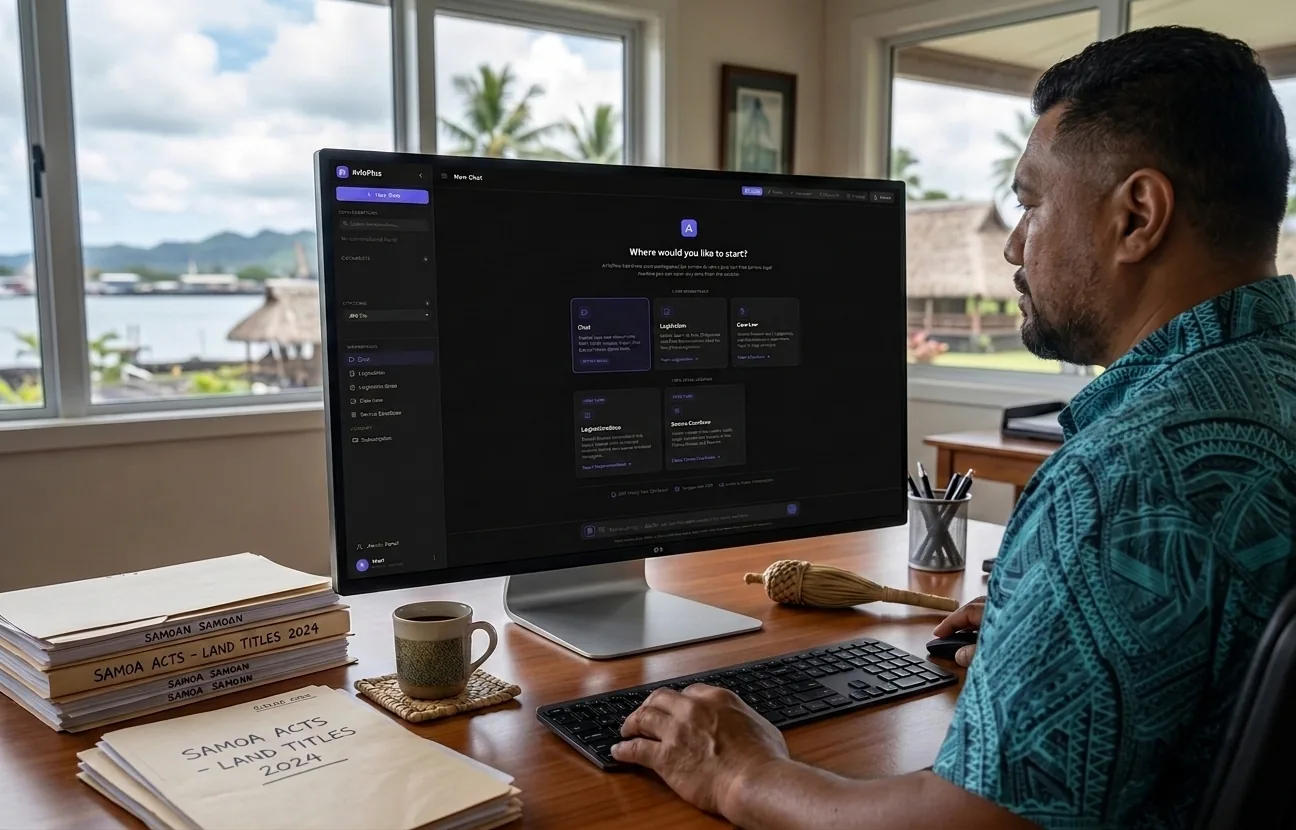
Traditionally, legal research in Samoa has been challenging due to limited digital access to legislation and case law. Many practitioners relied on printed volumes or visits to the Parliamentary Counsel Office. Today, AI-powered tools like ARLO+ are making Samoan legal research faster and more accessible.
ARLO+ provides AI search across Samoa's legislation database and court decisions, allowing lawyers, government professionals, and researchers to find relevant law using natural language queries rather than manual keyword searches.
Whether you're a practising lawyer, a government policy analyst, or a researcher studying Pacific legal systems, understanding Samoa's legal framework is the foundation of effective work in this jurisdiction.
Research Samoan Law with AI
ARLO+ provides AI-powered search across Samoa's legislation and case law databases.
Get Started →